
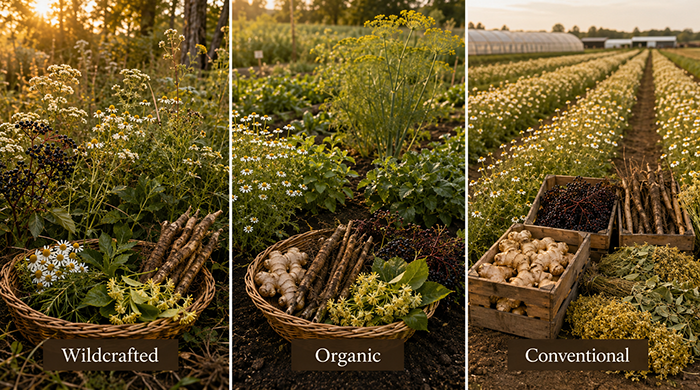
When choosing herbs, herbal teas, or plant extracts, you will often see words like wildcrafted, organic, and conventional. These words describe how the plant was grown, harvested, and handled before it reached you.
This matters because herbs are not just products. They come from soil, water, sunlight, air, and the environment around them. The quality of that environment affects the quality of the plant.
In an alkaline plant-based lifestyle, the goal is to choose herbs that are clean, natural, and aligned with the body’s need for mineral-rich plant support. Wildcrafted herbs are often preferred because they grow in nature. Organic herbs can also be a strong choice when they are clean, well-sourced, and properly handled. Conventional herbs require more caution because they may be grown with farming methods many people are trying to avoid.
Quick Comparison
| Type | How It Grows | Main Strength | What To Watch For |
|---|---|---|---|
| Wildcrafted | Grows naturally in the wild | Closest to a natural growing environment | Must be harvested ethically and away from polluted areas |
| Organic | Farm-grown under organic standards | Cleaner farming standards than conventional | Organic does not always mean wildcrafted or non-hybrid |
| Conventional | Farm-grown using standard commercial methods | Usually cheaper and easier to find | May involve synthetic chemicals, poor soil practices, or lower sourcing standards |
What Does Wildcrafted Mean?
Wildcrafted herbs grow naturally in the wild instead of being planted and managed on a farm. They grow in forests, meadows, mountains, fields, and other natural environments.
Because they grow outside of controlled farm conditions, wildcrafted plants respond to natural stressors. These may include changes in sunlight, rainfall, soil conditions, insects, competing plants, and seasonal shifts. This gives the plant a stronger relationship with its natural environment.
This is one reason many herbal traditions value wildcrafted herbs. They are seen as closer to the original expression of the plant because they grow according to nature’s rhythm rather than a commercial production system.
Why Wildcrafted Herbs Are Often Valued
Wildcrafted herbs are often valued because they may carry the strength of their natural environment. The plant grows where it is adapted to grow. It reaches for sunlight, draws minerals from the soil, and survives without being forced into a controlled agricultural pattern.
From the Dr. Sebi perspective, this matters because the body responds best to plants that are natural, mineral-rich, and not overly altered by modern food production. The closer the plant remains to its natural design, the better it fits the alkaline plant-based approach.
This does not mean every wildcrafted herb is automatically high quality. Wildcrafted herbs must be harvested from clean areas, identified correctly, dried properly, stored properly, and gathered with respect for the ecosystem.
Ethical Wildcrafting Matters
Wildcrafting is not simply taking plants from nature. True wildcrafting requires care, knowledge, and responsibility.
Good wildcrafting protects the plant, the land, and future growth. A person harvesting wild plants should know the plant, know the environment, and know how much can be taken without damaging the plant population.
Ethical Wildcrafting Guidelines
When harvesting wild plants:
- Never harvest endangered plants.
- Never harvest from polluted areas.
- Do not harvest near highways, industrial sites, sprayed lawns, or contaminated water.
- Do not pick immature plants.
- Do not take more than the plant population can recover from.
- Do not damage surrounding plants or soil.
- Harvest only what is needed.
- Leave enough behind for the plant to reproduce.
- Replant seeds when the whole plant or root must be harvested.
- Make sure the plant is correctly identified before using it.
Wildcrafted herbs are powerful only when the harvesting is clean, careful, and respectful.
What Does Organic Mean?
Organic herbs are grown on farms that follow organic production standards. In the United States, certified organic products must meet USDA organic requirements before they can be labeled organic.
Organic crop standards include rules about soil, pest control, seeds, and prohibited substances. USDA organic standards prohibit genetic engineering, ionizing radiation, and sewage sludge. Organic farms also rely first on management practices such as crop rotation, cover crops, biological controls, and approved substances when pest control is needed.
This makes organic herbs a better choice than conventional herbs for many people. Organic certification gives the buyer more protection than a label that simply says “natural.”
What Organic Does Not Mean
Organic is helpful, but it does not mean the same thing as wildcrafted.
Organic does not automatically mean:
- wildcrafted
- non-hybrid
- hand-harvested
- stronger
- fresher
- more mineral-rich
- free from all processing concerns
Organic means the plant was grown under organic rules. That is valuable, and it is not the same as growing naturally in the wild.
This is why a person following the Dr. Sebi nutritional guide may still prefer wildcrafted herbs when possible, while using organic herbs as a good second choice when the source is trustworthy.
What Does Conventional Mean?
Conventional herbs are grown using standard commercial farming methods. These methods can vary widely. Some farms may use careful practices, and others may rely heavily on synthetic fertilizers, pesticides, herbicides, poor soil practices, or mass-production methods.
The concern with conventional herbs is not that every conventional herb is automatically harmful. The concern is that the buyer usually has less protection and less information about how the herb was grown, sprayed, harvested, dried, stored, and processed.
For people using herbs to support wellness, this matters. Herbs are often consumed as teas, powders, extracts, or capsules. If the plant was grown in poor soil, sprayed heavily, or processed carelessly, the final product may not match the clean support the person is looking for.
Conventional Herbs Require More Caution
Conventional herbs may be cheaper and easier to find, but they require more caution.
When buying conventional herbs, ask:
- Where was the herb grown?
- Was it sprayed?
- Was it tested for heavy metals?
- Was it tested for mold?
- Was it tested for pesticide residues?
- Was it dried and stored properly?
- Is the company transparent about sourcing?
A low price is not always a bargain. If the herb is low quality, contaminated, stale, or poorly handled, it may not be worth using.
What About Essential Oils?
The words wildcrafted, organic, and conventional also appear on essential oil labels. This can be useful, because essential oils come from plants too.
Still, essential oils are different from herbal teas. They are highly concentrated plant extracts and should be used with greater caution. Essential oils should not be treated like whole herbs or teas.
For an alkaline plant-based lifestyle, herbal teas and whole herbs are usually the better foundation. Essential oils may have their place, but they should be used carefully, diluted when applied to the skin, kept away from the eyes, and never swallowed unless guided by a qualified professional.
Best Choice for the Alkaline Plant-Based Lifestyle
The best choice is usually:
- Wildcrafted herbs from a clean and ethical source
- Organic herbs from a trusted supplier
- Conventional herbs only when source and testing are clear
This does not mean you have to become extreme or fearful. It means you become more aware.
The body responds to quality. Clean herbs, clean food, clean water, proper rest, and reduced chemical exposure all work together. The goal is to lower the body’s total burden and give it better materials to work with.
Sources
[1] USDA Agricultural Marketing Service. “Organic Standards.”
[2] USDA Agricultural Marketing Service. “Allowed & Prohibited Substances.”
[3] U.S. Food and Drug Administration. “Questions and Answers on Dietary Supplements.”
[4] Dr. Sebi’s Cell Food. “Dr. Sebi’s Nutritional Guide.”
[5] Alkaline Plant Based Diet. “Wildcrafted Vs Organic Vs Conventional Herbs And Essential Oils.”